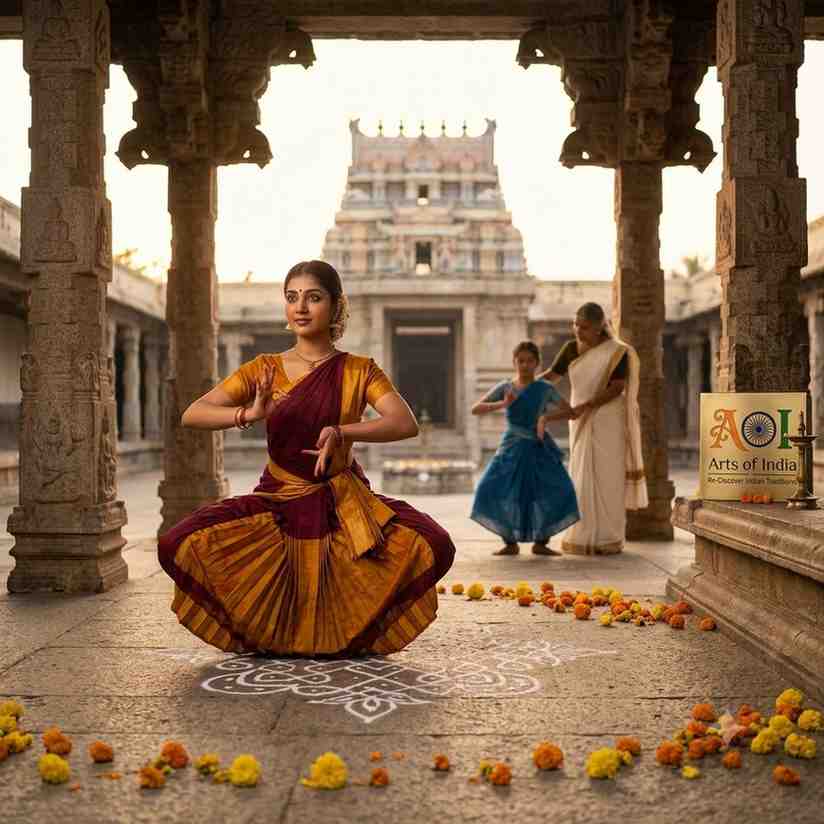
Bharatanatyam is one of India’s oldest and most expressive classical dance forms. Originating in the temples of Tamil Nadu, this ancient art blends precise rhythm, dynamic geometry, and deep emotional storytelling.
Whether you are looking to reconnect with your cultural roots, improve your posture and physical stamina, or master a traditional art form from home, learning Bharatanatyam online offers a structured and accessible path.
In this guide, you will explore the core foundations of Bharatanatyam, essential hand gestures (Mudras), basic footwork (Adavus), and a practical daily routine to kickstart your practice.
1. The Core Foundations of Bharatanatyam
Bharatanatyam is built on three distinct elements that work together to create a complete performance:
-
Nritta (Pure Technical Dance): Fast, rhythmic movements focusing on stance, footwork, and exact body geometry without emotional storytelling.
-
Nritya (Expressive Dance): A blend of rhythm and expression (Abhinaya), where hand gestures and facial expressions convey sacred stories and emotions.
-
Natya (Dramatic Element): The dramatic aspect of performance, using dance-drama techniques to portray characters and traditional narratives.
2. Essential Postures and Stances
Before practicing footwork, every dancer must master these fundamental postures:
Sthanakam (Standing Stance)
Standing upright with heels together, toes pointing outward at a wide angle, and shoulders relaxed.
Aramandi / Araimandi (Half-Squat Stance)
The signature posture of Bharatanatyam. Knees are bent sideways to form a diamond shape while maintaining a straight spine and heels together.
Muzhumandi (Full-Squat Stance)
A deep squatting position where you balance entirely on the balls of your feet with knees turned outward.
3. Essential Single-Hand Gestures (Asamyutta Hastas)
Hand gestures, known as Asamyutta Hastas, form the core visual vocabulary of Bharatanatyam, allowing dancers to convey complex meanings and emotions through simple hand positions. Among the most fundamental single-hand gestures is Pataka, where all fingers are held straight and extended together while the thumb bends slightly to touch the side of the index finger; this gesture is traditionally used to symbolize elements like clouds, forests, opening doors, or expressing a firm “no.” Building upon this position is Tripataka, which maintains the Pataka form but bends the ring finger downward at the knuckle, making it ideal for depicting a crown, a tree, a thunderbolt, or the act of applying a bindi. Finally, Ardhapataka modifies the position further by bending both the ring finger and the little finger downward together, a gesture frequently employed in classical dance to represent leaves, a knife, two distinct objects, or the bank of a river.
4. Fundamental Footwork (Adavus)
Adavus are the basic building blocks of Bharatanatyam performance. They combine specific foot contact, hand movements, body postures, and rhythmic beats (Talam).
-
Tatta Adavu (Tapping Step): Focusing purely on striking the soles of the feet flat on the floor while maintaining the Aramandi posture.
-
Natta Adavu (Stretching Step): Involves touching the floor with the heel or toe while extending the leg outward from the Aramandi stance.
-
Mettu Adavu (Heeled Step): Combining a small jump on the balls of the feet with a distinct heel strike on the floor.
5. A 20-Minute Daily Practice Routine
Consistency is key to building stamina, flexibility, and rhythm in classical dance. Use this simple structure for daily home practice:
-
Warm-Up (5 Mins): Ankle rotations, leg stretches, and torso twists to prepare your joints.
-
Posture Hold (3 Mins): Hold the Aramandi stance against a wall to build thigh strength and core stability.
-
Adavu Practice (8 Mins): Execute Tatta Adavu and Natta Adavu in three speeds (Trikala) to internalize rhythm.
-
Mudra Review (2 Mins): Hold Asamyutta Hastas while reciting their traditional Sanskrit names.
-
Cool Down (2 Mins): Gentle calf stretches and deep breathing.
Ready to Start Your Bharatanatyam Journey?
Learn ARTS of INDIA acts as a direct bridge between you and India’s rich cultural heritage—offering accessible, structured online classes led by expert gurus across dance, music, and art, while directly supporting rural artisans and preserving traditional skills for future generations.
Leave your comment
Related posts