“Puppets of India” – When India’s timeless storytellers found their place on a postage stamp
A puppet may be made of wood, leather, cloth or even a simple glove. But in the hands of a skilled puppeteer, it can become a king, a warrior, a deity, a clown—or an entire character from an ancient epic.
For generations, puppetry has been one of India’s most fascinating forms of storytelling. Across villages, temples, fairs and traditional theatre spaces, puppeteers have used movement, music, narration and colourful costumes to bring stories to life.
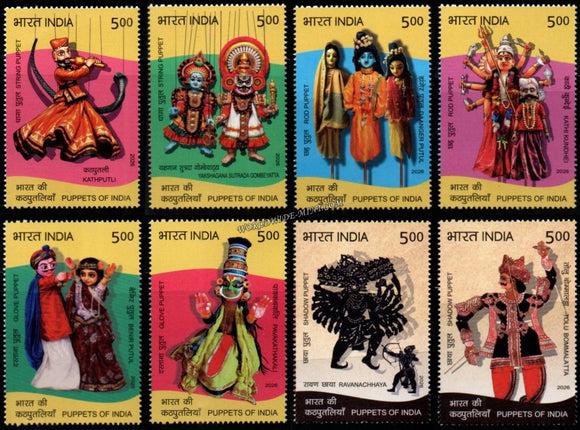
In recognition of this extraordinary heritage, the Department of Posts released a special set of eight commemorative postage stamps titled “Puppets of India” on 13 February 2026 at the India Habitat Centre, New Delhi. The series presents eight distinctive puppetry traditions from different parts of India and celebrates the craftsmanship, performance traditions and cultural memories carried by them.
For ARTSofINDIA, these stamps are more than collectibles. They are tiny windows into India’s living artistic heritage.
A Storytelling Tradition as Old as India’s Cultural Memory
Indian puppetry is not simply entertainment. It has traditionally been a way of transmitting stories, mythology, values, history and local traditions from one generation to another.
India’s traditional puppetry is broadly grouped into four major forms:
- 🧵 String Puppets
- 🪵 Rod Puppets
- 🧤 Glove Puppets
- 🌑 Shadow Puppets
Different regions developed their own techniques, characters, costumes, music and performance styles. Many traditions were preserved within families, with children learning by observing and assisting older members of the performing community.
The 2026 postage stamp series beautifully reflects this diversity.
The Eight Puppetry Traditions Featured on the 2026 Stamps
The “Puppets of India” issue contains eight ₹5 commemorative stamps, representing puppetry traditions from Rajasthan, Karnataka, West Bengal, Odisha, Kerala and Andhra Pradesh. The issue also includes associated philatelic products such as a First Day Cover, brochure, miniature sheets, sheetlets and a special cancellation.
Let us look at the eight traditions celebrated through these stamps.
1. Kathputli — Rajasthan


Few Indian puppetry traditions are as instantly recognisable as Kathputli.
Originating in Rajasthan, Kathputli is a traditional string puppetry form in which colourful wooden figures are manipulated using strings. The puppets are often dressed in elaborate Rajasthani costumes, with bright colours, jewellery and expressive features.
Kathputli performances have traditionally drawn upon folk legends, heroic tales, romance, mythology and stories of Rajasthan. The puppeteers combine manipulation, narration, music and dramatic movement to create an entire theatrical performance.
The tradition is particularly associated with the Bhat community, whose families have historically carried the art from one generation to another.
The inclusion of Kathputli in the 2026 stamp series brings one of India’s best-known folk theatre traditions into the world of philately.
2. Yakshagana Sutrada Gombeyatta — Karnataka


In Karnataka, puppetry has developed a fascinating relationship with the dramatic tradition of Yakshagana.
Sutrada Gombeyatta is a string puppet tradition whose performances draw inspiration from Yakshagana in their costumes, characters, music and storytelling.
Large wooden puppets are controlled with strings, allowing them to perform dramatic and sometimes highly elaborate movements. Stories frequently come from the Ramayana, Mahabharata and Puranic traditions.
The puppets themselves are often richly decorated, reflecting the visual vocabulary of Yakshagana theatre.
This makes Sutrada Gombeyatta a wonderful example of how Indian art forms do not exist in isolation—they influence, borrow from and grow alongside one another.
3. Daanger Putul — West Bengal


From eastern India comes Daanger Putul, a traditional rod puppet form of West Bengal.
Unlike string puppets, these large puppets are manipulated using rods. Their scale and expressive costumes give performances a striking theatrical quality.
Daanger Putul performances have included episodes from the Ramayana, along with social, historical and folk narratives. Performances traditionally combine singing, dialogue, music, gesture and dramatic presentation.
The puppets may be elaborately dressed with crowns and theatrical costumes, transforming the puppet stage into a miniature folk theatre.
The 2026 stamp provides a glimpse of this distinctive Bengali tradition and reminds us that puppetry in India has always been much more than children’s entertainment.
4. Kathi Kundhei — Odisha


Kathi Kundhei is associated with Odisha’s rich puppetry heritage.
The name refers to dolls or puppets manipulated with kathi, meaning a wooden rod. The tradition is associated with storytelling based on India’s great epics and religious narratives.
Performances can draw upon episodes from the Ramayana, Mahabharata and Puranas, often beginning with an invocation before the main story is introduced.
Odisha has a particularly rich puppetry landscape, with both string and shadow traditions surviving alongside other forms. Kathi Kundhei therefore represents one part of a much larger Odia theatrical heritage.
5. Benir Putul — West Bengal


The Benir Putul tradition of West Bengal introduces another important form of Indian puppetry—the glove puppet.
Unlike a string or rod puppet, a glove puppet is worn and manipulated directly by the puppeteer’s hand.
This seemingly simple technique can produce surprisingly expressive characters. The puppeteer can control the puppet’s head and limbs directly, allowing quick gestures and lively interaction.
Benir Putul demonstrates the remarkable variety within Bengali puppetry, where rod, string and glove traditions have developed alongside one another.
6. Pavakathakali — Kerala


Kerala’s Pavakathakali is a fascinating meeting of puppetry and one of India’s most visually dramatic theatrical traditions—Kathakali.
The puppets reproduce the visual language of Kathakali, including its characteristic costumes, colours and dramatic appearance.
Performed as glove puppets, they allow the puppeteer to recreate the gestures and characters associated with Kerala’s famous dance-drama tradition.
Pavakathakali demonstrates something particularly beautiful about Indian traditional arts: one art form can become a miniature version of another while developing its own identity.
7. Ravanachhaya — Odisha


Perhaps the most mysterious-looking tradition in the collection is Ravanachhaya, Odisha’s celebrated shadow puppetry tradition.
Unlike puppets that are viewed directly by the audience, shadow puppets appear as silhouettes projected onto a screen with the help of light.
The puppets are traditionally made from leather and can be manipulated between the light source and screen to create moving shadows.
Ravanachhaya has strong connections with the Ramayana and other religious and poetic narratives. Its visual simplicity can produce an extraordinarily atmospheric form of theatre.
The name itself is associated with Ravana’s shadow, adding another layer of mythology to this ancient performance tradition.
8. Tolu Bommalatta — Andhra Pradesh


The eighth stamp takes us to Andhra Pradesh, where Tolu Bommalatta represents one of India’s important leather shadow-puppetry traditions.
Traditionally crafted from treated animal hide, the puppets are often perforated and painted so that light can pass through parts of them, creating richly detailed silhouettes and translucent colours on the screen.
The puppets can be considerably larger than those used in some other Indian shadow traditions.
Performances traditionally draw upon stories from the Ramayana, Mahabharata and other religious and folk narratives, accompanied by music, dialogue and narration.
Tolu Bommalatta is a remarkable example of how leather, light, music and storytelling can come together to create a complete theatre.
Eight Stamps, Four Puppetry Forms
One of the most interesting aspects of the 2026 collection is that it does not represent only one style of puppetry.
Instead, the eight stamps collectively showcase India’s four broad puppetry categories:
| Puppetry form | Examples in the 2026 stamp series |
|---|---|
| 🧵 String Puppets | Kathputli, Yakshagana Sutrada Gombeyatta, Kathi Kundhei |
| 🪵 Rod Puppets | Daanger Putul |
| 🧤 Glove Puppets | Benir Putul, Pavakathakali |
| 🌑 Shadow Puppets | Ravanachhaya, Tolu Bommalatta |
This diversity is precisely what makes the collection culturally significant. The stamps are not simply portraits of puppets—they represent different regional approaches to theatre, craftsmanship, storytelling and performance.
More Than a Stamp: A Miniature Record of Living Heritage
Postage stamps are often treated as small pieces of paper that travel with letters.
But philately can also be a form of cultural documentation.
India Post itself describes stamps as ambassadors of the country’s heritage, and its philately programme presents stamps as objects through which people can explore India’s history, art and cultural expression.
The 2026 Puppets of India issue is a beautiful example.
Each stamp freezes a moment of a much larger performance tradition.
A puppet that normally moves across a stage is captured in a tiny printed image.
A costume that normally appears under theatre lights becomes part of a collector’s album.
A character traditionally brought alive by a puppeteer becomes a permanent visual record.
In this sense, the postage stamp becomes another stage for the puppet.
The Artists Behind the Puppets
Behind every puppet is a maker.
Behind every performance is a puppeteer.
And behind every surviving tradition are generations of families, communities and cultural practitioners who have kept the knowledge alive.
The Department of Posts notes that many Indian puppetry traditions have been sustained through family transmission, with younger generations learning by watching and assisting their elders.
The 2026 issue was designed by Sankha Samanta, while artistic references and text were provided by institutions and practitioners including the Sangeet Natak Akademi, Indira Gandhi National Centre for the Arts, Daricha Foundation and Dadi Pudumjee, founder of The Ishara Puppet Theatre Trust.
This collaborative effort is significant because documenting traditional arts requires more than simply photographing an object. It requires understanding its history, performance context, regional identity and the people who continue to practise it.
Puppets of India on Postage Stamps: A Collector’s Treasure
For philatelists, the 2026 issue offers an attractive thematic collection.
The eight individual stamps are all ₹5 denominations, issued on 13 February 2026. The Department of Posts also produced a First Day Cover, brochure, miniature sheets, sheetlets and a special cancellation connected with the issue.
For an Indian art enthusiast, however, the collection can be appreciated in another way.
It can become a small visual map of Indian puppetry:
Rajasthan → Karnataka → West Bengal → Odisha → Kerala → Andhra Pradesh
Eight stamps.
Eight traditions.
Several centuries of storytelling.
Countless artists.
And one extraordinary cultural idea:
A story can live as long as someone is willing to tell it.
India Post’s Puppets of India — 2026


The 2026 Puppets of India stamp issue is therefore much more than a philatelic release.
It is a celebration of the imagination of Indian artists.
It recognises traditions that have survived through changing times.
And it gives India’s puppets a new stage—one that can travel across the country and the world in the form of a postage stamp.
At ARTSofINDIA, we believe that India’s traditional arts deserve not only to be remembered, but discovered, learned, taught and carried forward.
These stamps invite us to do exactly that.
Look closely at a puppet, and you may see a character.
Look closer, and you may see a story.
Look even closer, and you may discover India.
The Eight Puppets at a Glance
Kathputli — Rajasthan | String Puppet
Yakshagana Sutrada Gombeyatta — Karnataka | String Puppet
Daanger Putul — West Bengal | Rod Puppet
Kathi Kundhei — Odisha | Rod/String tradition
Benir Putul — West Bengal | Glove Puppet
Pavakathakali — Kerala | Glove Puppet
Ravanachhaya — Odisha | Shadow Puppet
Tolu Bommalatta — Andhra Pradesh | Shadow Puppet
The Department of Posts officially identifies these eight traditions as the subjects of the 2026 commemorative issue.
Discover. Learn. Teach. Preserve.
India’s puppetry traditions are not relics of the past. They are part of India’s living heritage.
Explore more traditional Indian arts, crafts, music, dance and storytelling traditions with ARTSofINDIA.
India’s Arts. Our Pride. Their Tomorrow.
Leave your comment
Related posts